Written by: Nuno Leiria, Founder & CEO @ Nilo
Key Takeaways for You as a Roblox Builder
-
Roblox builders like you often hit a wall when moving to standalone engines such as Unreal Engine because of steep learning curves, installation friction, and limited asset ownership.
-
Standalone engines give you full ownership and export flexibility, but they demand heavy technical setup and programming knowledge that can kill your creative momentum.
-
AI-assisted browser-based tools close this gap by removing installs, automating optimization, and letting you script with natural language so you can create faster.
-
Features like real-time LOD, vibe coding, and multi-format exports turn browser tools into practical alternatives or clear stepping stones toward professional engines.
-
Nilo combines a custom WebAssembly engine with model-agnostic AI to deliver these features in your browser, so you can start building right away with no install.
The Ownership Gap Between Roblox and Standalone Engines
Roblox Studio makes building feel easy and familiar. The tools sit in front of you, the physics behave well, and millions of builders already understand the environment. Everything you create stays inside Roblox’s ecosystem though. Your assets, your worlds, and your game logic live under platform terms that control what you can sell, export, or move elsewhere. That limitation creates a real ownership gap.
Standalone engines like Unreal Engine and Unity flip that situation. You own your project files. You can export to many platforms, publish on Steam, or build something completely outside any walled garden. Unreal Engine supports full scene assembly with Blueprints, C++, physically based materials, and Nanite virtualized geometry for high-detail meshes. The power feels huge, and the learning curve feels huge too.
The friction shows up everywhere. You deal with installation files, driver requirements, Lua versus C# versus GDScript debates, and long retopology sessions. Retopology means manually cleaning a 3D mesh so it runs efficiently in a game engine. You often face all of that before a single asset becomes usable.
Why Friction Kills Your Momentum and Slows Learning
Advanced creator tools now expect real programming ability and proper testing setups. If you come from Roblox, that jump can feel like a vertical wall.
Momentum keeps you learning. When you spend three hours installing Unity, configuring a project, and watching a mesh import sideways, you do not learn game development. You learn frustration. If you hit that wall again and again, you usually do not level up. You close the project. As one builder said in Nilo’s February 2026 survey, “Picture yourself, frustrated because you spent the last 5 hours 3D modeling a shipping container.”
Rising technical barriers are already pushing the industry toward AI-powered tools and prompt-based workflows that lower the skill threshold. That shift has started and now supports a new category of tools built specifically for the gap you are in right now. These AI-assisted browser-based platforms remove installation friction and automate the technical work that usually blocks you.
The Solution Category: AI-Assisted Browser-Based 3D Tools
AI-assisted browser-based 3D tools sit between platform-locked creation such as Roblox Studio and professional standalone engines such as Unreal Engine and Unity. They run entirely in your browser with no installation and no downloads. AI handles the technical work that usually stops beginners, including mesh generation, retopology, rigging, and scripting.
The browser side changes your workflow. Browser-based AI 3D tools can perform real-time optimization at export by generating LOD chains, reducing polygon counts, baking normal and roughness maps, and applying platform-specific texture compression. Tasks that once needed Blender, InstaLOD, and a separate export pipeline now happen automatically.
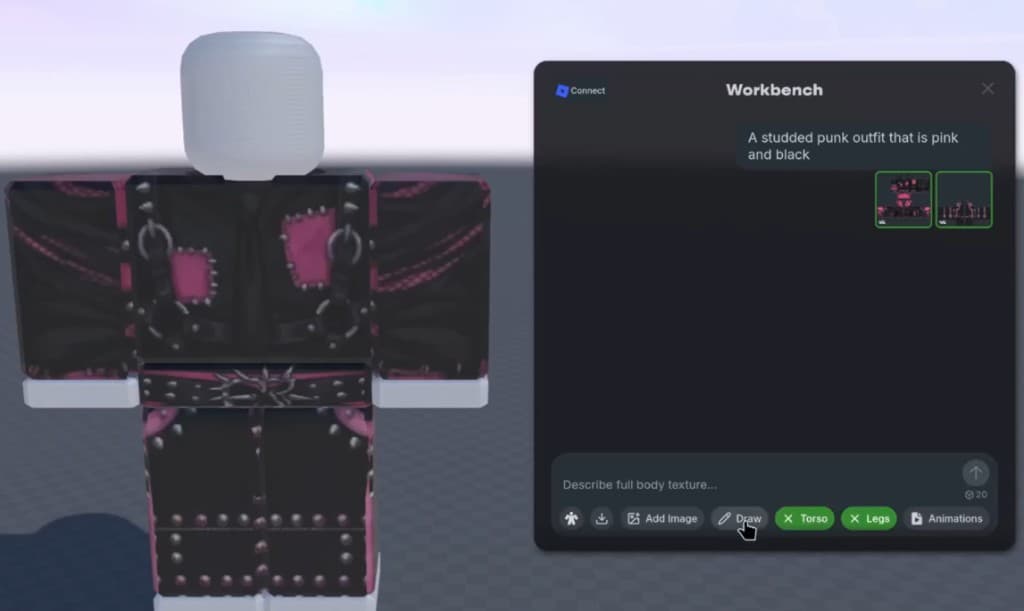
The AI side matters too, but not as “AI does everything while you watch.” The strongest tools in this category use what builders call vibe coding. You describe what you want in plain language using text, voice, or even a sketch. The AI then generates working code or 3D assets with real-time feedback. You stay in control. You stay inside your world. You keep building instead of wrestling menus.
That mix of control and speed separates useful AI tools from short-lived gimmicks. Nilo stands out in this category because it combines a custom game engine, built with C++ physics compiled to WebAssembly and WebGPU graphics, with a model-agnostic AI layer. The AI layer pulls from multiple providers like Meshy, Tripo, and Uthana and automatically uses whichever returns the strongest result. The approach works: in Nilo’s February 2026 survey, 93% of builders said they would recommend it to a friend, and 82% rated their experience as “Awesome” or “Good.”

Capability Breakdown: What to Look For in Each Tool
3D Asset Generation That Feels Fast
You should choose tools that accept text prompts, sketches, or reference images and return clean, game-ready geometry. Production-ready platforms can generate models from a single reference image and export in formats like FBX, GLB, USD, and USDZ with built-in topology cleanup. Nilo’s sketch-to-3D pipeline lets you draw in 2D, refine with AI, and drop assets straight into your world without a Blender detour.

Scripting Alternatives That Match Your Skill Level
Visual scripting replaces lines of code with connected logic blocks. Unreal Engine uses Blueprints. Unity offers Visual Scripting, previously called Bolt. Godot includes its own node-based visual scripting system. These options improve on raw code but still require you to think like a programmer.
Nilo’s vibe coding, described earlier, applies that natural language approach directly to character behavior and game logic. You describe behavior in plain language and see working code run instantly in your 3D world. One builder said, “You made me enjoy vibe-coding. The code assistance works almost flawlessly, other experiences have just been frustrating at best.”
World Building That Keeps You in Flow
Roblox Studio’s part-based building feels spatial and familiar. Unreal Engine’s level editor offers deep power but also heavy complexity. Browser tools like Nilo use a radial menu for quick object creation and an inspector panel for detailed editing. Physics simulation runs in real time by default, so you do not wire basic interactions by hand.

Optimization That Happens in Real Time
Roblox caps assets at 10K to 20K polygons. Hitting that target manually often means hours in Blender. Dedicated optimization tools can cut polygon counts by more than 10x while keeping visuals strong, but they add another tool to your stack.
Nilo’s real-time LOD system adjusts polygon counts on the fly inside the platform. You move a slider and Nilo handles the math, so you keep your focus on how the world feels instead of on triangle counts.

Collaboration That Starts With a Link
Unreal Engine and Unity support version control through Git or Perforce, which you must set up and maintain. Nilo supports real-time multiplayer creation. You share a URL and build together on desktop or mobile instantly.
Export That Protects Your Ownership
You still need to import exported assets into your final engine and check performance after automated optimization. Nilo exports to FBX, OBJ, STL, and glTF, which work with Roblox, Unity, Unreal Engine, Blender, and VRChat. Your work does not stay trapped in a single platform.
The table below shows how each tool balances scripting style, installation friction, export options, and browser support. Use it to match your current skills and hardware to the right starting point.
|
Tool |
Visual Scripting Method |
Install Required |
Export Options |
Browser Support |
|---|---|---|---|---|
|
Natural language vibe coding (text, voice, image prompts) |
No |
FBX, OBJ, STL, glTF — Roblox, Unity, Unreal, Blender, VRChat |
Full (WebGPU + WebGL fallback) |
|
|
Yes (desktop app) |
Unity-native builds; FBX import |
Partial (Unity Studio web editor, limited) |
||
|
Unreal Engine |
Yes (large desktop install) |
FBX, OBJ, USD; multi-platform builds |
No |
|
|
Godot |
Visual scripting nodes, GDScript |
Yes (lightweight desktop app) |
GLTF, OBJ; HTML5 export available |
No (editor); HTML5 game export only |
|
PlayCanvas |
JavaScript scripting |
No (browser editor) |
GLB, FBX; WebGL games |
Full (browser editor) |
|
Rosebud AI |
AI code generation (vibe coding) |
No |
Limited; web-only games |
Full |
See how Nilo’s browser-based approach compares in practice and create your first world in minutes.
Neutral Evaluation Criteria for Choosing a Tool
When you compare tools for your own projects, follow a simple order so your decision feels clear.
Ownership and portability. Start here. Check whether you can export assets in standard formats such as FBX and glTF and use them anywhere, or whether they stay locked to one platform. This choice decides if the tool becomes a stepping stone or another walled garden.
Install friction. Next, look at setup. See whether the tool needs a desktop download, specific hardware, or account setup before you can create anything. Zero-install tools protect your momentum, especially when you feel excited about a new idea.
Scripting accessibility. Once you know you can start quickly and keep ownership, look at how you add logic. Check whether the tool expects raw code, visual node graphs, or plain-language descriptions. Match this to your current skill level and how fast you want to learn.
Optimization pipeline. Then review how the tool handles performance. See whether it manages polygon reduction and texture compression automatically or whether you must rely on Blender and a separate LOD tool.
Collaboration model. Think about how you want to build with friends. Some tools require version control setup. Others let you share a link and edit together in real time.
Export compatibility. Finally, confirm that exports match your target platform. Check polygon and texture budgets, such as 10,000 to 100,000 triangles for real-time engines and under 50,000 for mobile and WebGL.
Three Builder Scenarios and Where You Might Fit
Scenario 1: You build in Roblox and want cleaner assets. You already ship Roblox experiences but spend 30 or more minutes per asset in Blender doing manual retopology. A browser-based tool with real-time LOD, like Nilo, lets you generate, optimize, and export Roblox-ready assets without leaving your creative flow. The time savings mentioned earlier, such as cutting long retopology sessions down to seconds, directly target this bottleneck.
Scenario 2: You build environments and feel blocked by scripting. You can design spaces, but game logic stops you. Godot’s visual scripting improves on Lua, yet it still expects logic thinking. Nilo’s vibe coding lets you describe behavior in plain language and see it run instantly in 3D. The interface still exposes real concepts like speed variables and physics properties, so you learn while you build.
Scenario 3: You feel ready for standalone ownership. You want your game on platforms beyond Roblox. Unreal Engine gives you AAA-quality visuals and full ownership, but the install, learning curve, and hardware needs feel heavy. A practical path uses Nilo to generate and optimize assets, export to FBX or glTF, then import into Unreal Engine or Unity for final publishing. You gain ownership without starting from zero inside a professional tool.
Frequently Asked Questions
Is Unreal Engine good for Roblox builders who are just starting out?
Unreal Engine ranks among the most powerful game engines available, and it targets professional developers. It needs a large desktop installation, strong hardware, and knowledge of either Blueprints or C++ before you can build interactive content. Many Roblox builders find that jump too steep without an intermediate step. Starting with a browser-based tool that handles optimization and scripting automatically, then exporting to Unreal Engine later, usually works better than jumping straight in.
Can I use Godot as a Roblox Studio alternative?
Godot is a free, open-source engine with a lighter install than Unity or Unreal Engine. It supports visual scripting alongside its own language, GDScript. You can treat it as a real option if you want standalone ownership and feel ready to learn a new environment. You still face the usual desktop friction though, including installation, a new interface, and a scripting system that expects logic thinking. Godot does not include built-in AI asset generation or real-time retopology, so you still rely on external tools for 3D modeling.
What does “browser-based” actually mean for game creation tools?
Browser-based tools run entirely in your web browser with no download, no installation, and no specific operating system requirement. You open a link and start creating. Modern browsers support WebAssembly and WebGPU, which let complex 3D rendering and physics run at near-native speed. The same shift allowed Figma to replace many desktop design apps. For game creation, this means you can build on almost any device, share your world with a link, and collaborate in real time without asking friends to install anything.
Do I need to know how to code to use these alternatives?
The answer depends on the tool you choose. Unreal Engine’s Blueprints and Godot’s visual scripting reduce the amount of raw code you write, but you still need to understand conditions, loops, and variables. Tools with natural language code editors let you describe what you want in plain English while the AI generates working code. You can still open and edit the real variables if you want to learn, but you do not have to. Your choice should match how much you want to learn to code versus how quickly you want to ship ideas.
Conclusion: A Practical Bridge From Roblox to Standalone Engines
The strongest bridge between Roblox Studio and standalone engines combines zero-install browser access, natural language scripting through vibe coding, real-time polygon optimization, and standard-format export to platforms like Unreal Engine, Unity, and Roblox. Unreal Engine delivers ownership and visual fidelity but demands serious setup. Godot and Unity lower the barrier without removing it. AI-assisted browser tools, with Nilo standing out for its custom game engine, real-time LOD system, and direct Roblox export, close this gap while protecting your creative flow. Use the comparison table above to match each tool to where you are right now.
Ready to build without the install friction? Start creating in Nilo’s browser-based engine today.