Written by: Nuno Leiria, Founder & CEO @ Nilo | Last updated: July 23, 2026
Key Takeaways for Roblox Builders Like You
- An AI 3D game engine mixes natural language prompts with a real game engine. You build interactive 3D worlds in your browser without downloads, installs, or coding.
- As a Roblox builder, you need browser access, hands-on editing, clean exports under 10K–20K polygons, and a single workflow that removes constant tool switching.
- Browser-based engines that use WebGPU and WebAssembly remove hardware barriers. You can create in real time on school laptops, shared devices, and mobile browsers.
- Automatic retopology, FBX/glTF export, and real-time LOD keep your models inside Roblox’s limits without manual Blender cleanup.
- Nilo brings these five pieces together in one browser-based platform, so you can start building in your browser today.
Quick Comparison: 7 Roblox-Friendly Tools Side-by-Side
When you compare tools, focus on four things that matter for Roblox work. Check if it runs in the browser, how much creative control you get, whether it exports clean files, and what it costs to start.
| Tool | Browser-Based | Hands-On Editing | Roblox Export Quality |
|---|---|---|---|
| Nilo | Yes, no install needed | Full hands-on editing plus AI assist | Real-time retopology, auto LOD, FBX/glTF export tuned for Roblox’s 10K–20K polygon cap |
| Unity | No, desktop editor required, WebGL is an export target, not a browser editor | Full editing, C# scripting required | Manual export pipeline, no Roblox-specific optimization |
| Roblox Studio | No, desktop install required | Full editing, Lua scripting required | Native, but you build inside Roblox Studio itself |
| Blender | No, desktop only | Full editing, steep learning curve | Manual retopology and export, polygon cleanup required |
| PlayCanvas | Yes, browser editor | Full editing, JavaScript scripting required | No Roblox-specific export pipeline |
| Rosebud AI | Yes | Prompt-only, no scene tree or asset pipeline | No Roblox export |
| Lemonade.gg | Partial, plugin for Roblox Studio | AI assist inside Roblox Studio only | Dependent on Roblox Studio workflow |
Nilo stands out because it combines browser access, hands-on editing, real-time physics, and Roblox-ready exports in one place, backed by a community of 9,000+ builders on Discord. In a February 2026 Nilo survey, 93% of builders said they would recommend Nilo to a friend, and 82% rated their experience as “Awesome” or “Good.”
Try Nilo’s browser-based editor with no install required.
What You Actually Need from an AI 3D Game Engine
Feedback from Nilo’s February 2026 builder survey points to five things that separate useful tools from flashy demos.
- Speed: You do not have time to spend hours in Blender for a single prop. You need a tool where generating an asset takes seconds, not an afternoon. One builder said, “I do not have to spend hours on 3D modeling the simplest things. Now I can use Nilo and do it in 15 seconds.” Speed helps you try more ideas in the same session.
- Creative control: You want “no more AI lottery.” Prompt-only tools give you whatever the AI decides, which wastes the time you just saved. You need to iterate, adjust, and build exactly what you see in your head. Once you have that control, the next challenge becomes getting your work into Roblox.
- Clean Roblox exports: Messy topology, the structure of a 3D mesh, turns into hours of cleanup. You need exports that pass Roblox’s performance checks without opening Blender. Clean meshes keep your game smooth for players.
- Single-tool workflow: Bouncing from Meshy to Blender to Roblox Studio kills your momentum. You stay in flow when one tool handles generation, editing, and export. One tool, zero friction.
- Community: You should be able to say, “I can finally build what’s in my head, with a community that gets it.” Building alone feels draining. Building alongside other creators who share techniques and give feedback keeps you shipping worlds instead of stalling out.
Browser vs. Downloadable Tools for Roblox Builders
Downloadable engines create real friction when you build on a school laptop, a shared family computer, or a mid-range device. Roblox Studio, Unity, and Blender all require installation, and Unity and Blender both run better on higher-end hardware.
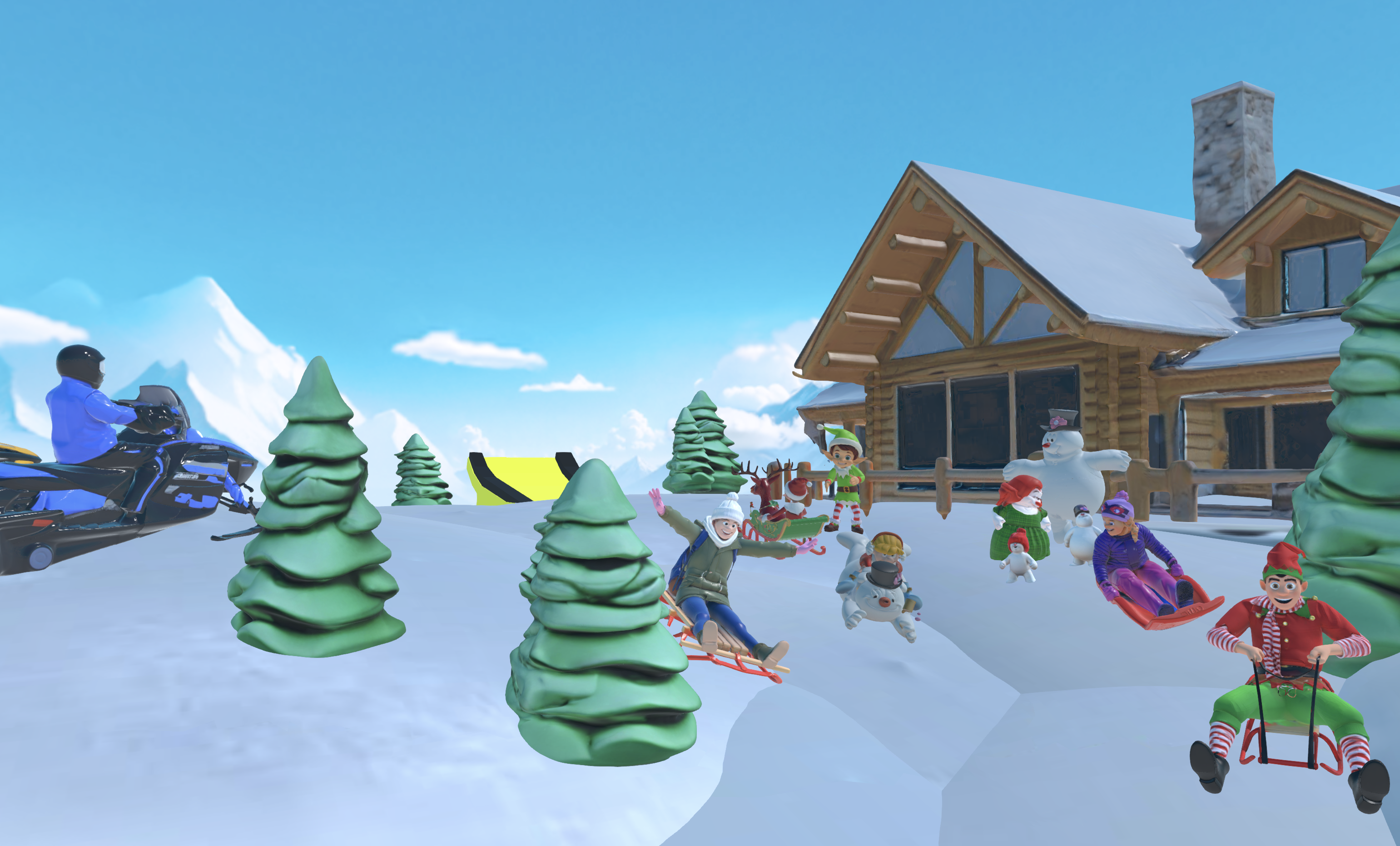
Browser tools remove that barrier. WebGPU and WebAssembly now close much of the performance gap between browser and native apps, so real-time 3D creation works in a tab. Nilo’s custom engine uses C++ physics compiled to WebAssembly and WebGPU rendering with a WebGL fallback, so it runs on most devices without setup.
When you check if a browser-based tool will run well for you, look for three things.
- WebGPU support with a WebGL fallback for older hardware
- Support for mobile browsers, not just desktop Chrome
- Shareable links so a friend can jump in instantly
As of early 2026, WebGPU ships across all major browsers with roughly 70% global support, including Safari on iOS since late 2025. Tools built on this stack, like Nilo, run on devices you already own.
How to Judge Export Quality for Roblox
Roblox enforces strict performance limits around 10K–20K polygons or triangles per model with 1024×1024 textures. Many AI-generated models blow past these limits and need manual retopology, which means rebuilding the mesh to reduce complexity, before they work in Roblox.
When you test any AI 3D tool for Roblox export, check three areas.
- Automatic polygon reduction: The tool should reduce triangle counts to fit Roblox’s caps without manual Blender work.
- Format support: Roblox accepts FBX for rigged or animated models, glTF/GLB for web assets, and OBJ for simple static meshes. Make sure the tool exports at least FBX and glTF.
- Rig compatibility: For characters, the rig, or skeleton, should survive export without broken or stretched movement.
Nilo’s real-time LOD system adjusts polygon counts on the fly, so your models stay under Roblox’s caps automatically. You skip Blender cleanup. One builder said in Nilo’s February 2026 survey, “I like how it feels like a good game engine rather than a vibe coding tool, with easy building and a good focus on being able to export and import content.”

Hands-On Iteration vs. Prompt-Only Generation
Prompt-only tools like Rosebud AI generate a result from text, then stop. Browser-tab-only AI game makers output a web page instead of an editable project, with no scene tree or asset pipeline. If you want a small change, you re-prompt and hope.
A real AI 3D game engine gives you AI plus full editing. To test creative control in any tool, try a few quick experiments.
- Generate an asset, then change one detail. See if you can do that without regenerating everything.
- Place an object in a scene and move it. Check if physics reacts in real time.
- Combine a sketch or image with a text prompt. Confirm the tool accepts multiple input types.
Nilo stands out here because it accepts text prompts, sketches, and reference images together, then lets you edit directly inside the 3D world. A 2026 comparative study found that AI-assisted pipelines work best for ideation and rough prototypes, while hands-on editing stays essential for optimization and art direction. Nilo leans into that mix. One builder said in Nilo’s February 2026 survey, “It lets my imagination free and let loose instead of having to plan out a whole blueprint on what to make with my past modeling tools.”
Free Tier Reality Check for AI 3D Tools
Most AI 3D tools give you a free tier, but the limits change a lot from tool to tool. When you compare them, look at how many assets you can generate each month, whether export is included, and whether collaboration features sit behind a paywall.
Nilo’s free tier includes 1,000 Nilo Bits per month. These credits cover AI generation, export, and creation, while many core building features use no Bits at all. You can earn more Bits through Nilo Rewards by inviting friends and building with the community.
Community support matters as much as credits. A community of this size means you can find technique guides, get feedback on your work, and collaborate with creators who build worlds like yours. Builders in the survey also praised the team’s responsiveness: “The Developers are awesome at responding and making the tools we need to be successful.”
Claim your 1,000 free Nilo Bits and start creating.
Common Roblox Roadblocks and How Real Engines Help
If you have tried to build a Roblox world before, you have probably hit at least one of these walls.
- Scripting: Roblox Studio uses Lua and Unity uses C#. Most builders are not coders, and learning a language just to open a door feels exhausting. Nilo’s vibe coding editor lets you describe what you want, then the AI writes the code, so you avoid that first scripting wall.
- Modeling time: One builder said, “Picture yourself, frustrated because you spent the last 5 hours 3D modeling a shipping container. All I have to do is open Nilo and do it in 20 seconds.” Traditional 3D modeling that previously required hours or days can now be completed in minutes with AI tools, but only when the tool handles retopology for you.
- Tool-switching: The Meshy to Blender to Roblox Studio pipeline breaks your creative flow every time you switch apps. AI-generated assets often ship with dense geometry and fragmented UV maps that need human cleanup before engine use, unless the tool fixes that automatically.
- Optimization stress: High part counts, laggy unions, and low FPS make your game feel rough. Nilo’s real-time LOD system handles polygon optimization for you, so you can focus on design instead of polycounts.
The single-tool workflow separates Nilo from daisy-chain setups. Generation, rigging, animation, vibe coding, world building, and export all happen in one place. One builder said in Nilo’s February 2026 survey, “There are no limits on what you can create, just type, draw or add in an image and you can generate, rig, customise and place a fully 3D model within minutes.”
FAQ
What is the difference between an AI 3D game engine and a prompt-to-game tool?
A prompt-to-game tool generates a playable result from text, then locks it. You cannot meaningfully edit what comes out. An AI 3D game engine gives you a real engine under the AI, with a scene tree, physics simulation, asset pipeline, and hands-on tools. You build, iterate, and export like a game developer without coding everything from scratch. Nilo works as a game engine first, with AI as your co-pilot instead of the only worker.
Do I need a powerful computer to use a browser-based AI 3D game engine?
You often do not. Browser tools like Nilo run on WebAssembly and WebGPU, which support a wide range of devices, including mid-range laptops and mobile browsers. Nilo includes a WebGL fallback for older hardware. Very old devices or ones with limited memory may feel slower. The easiest test is to open the tool in your browser and try a basic build, with no install.
How does Roblox’s polygon limit affect which AI tool I should use?
As mentioned earlier, Roblox caps meshes at around 10K–20K triangles depending on import method. Many AI models exceed that and need manual retopology in Blender. When you choose a tool, pick one that handles polygon reduction automatically. Nilo’s real-time LOD system adjusts polygon counts so exports meet Roblox’s requirements without manual cleanup.
Can I use Nilo if I have never built anything in Roblox before?
Yes. Nilo supports builders at every stage, from players who have never touched a 3D tool to experienced Roblox creators who want a faster workflow. You can generate assets from a text prompt, a sketch, or a reference image, then drag them into a 3D world and playtest with friends, all in the browser. You do not need modeling or scripting experience to start.
What file formats does Nilo export, and where can I use them?
Nilo exports to FBX, OBJ, STL, and glTF, which work with Roblox Studio, Unity, Unreal Engine, Blender, and VRChat. Nilo does not lock you in. You can use it as an asset creation pipeline for Roblox or build and publish worlds directly inside Nilo. Rigged and animated models export with their skeletons and animation data intact for any compatible platform.
Recap and Your Next Step as a Roblox Builder
When you pick an AI 3D game engine for Roblox, five criteria matter most. You need automatic retopology for clean Roblox exports, hands-on creative control beyond prompts, browser access with no install friction, a single-tool workflow that keeps you in flow, and an active builder community that helps you level up.
Nilo stands out as a browser-based option that covers all five. You get real-time LOD optimization, multimodal generation from text, sketch, and image, vibe coding for game logic, and an active builder community on Discord. Nilo is in open beta, free to try, and built for Roblox creators who want to spend time designing worlds instead of fighting polycounts.
Nilo today gives you a fast, precise way to create Roblox-ready assets. Full game creation and publishing sit on its roadmap.
Join 9,000+ builders in Nilo’s open beta, it is free to start.